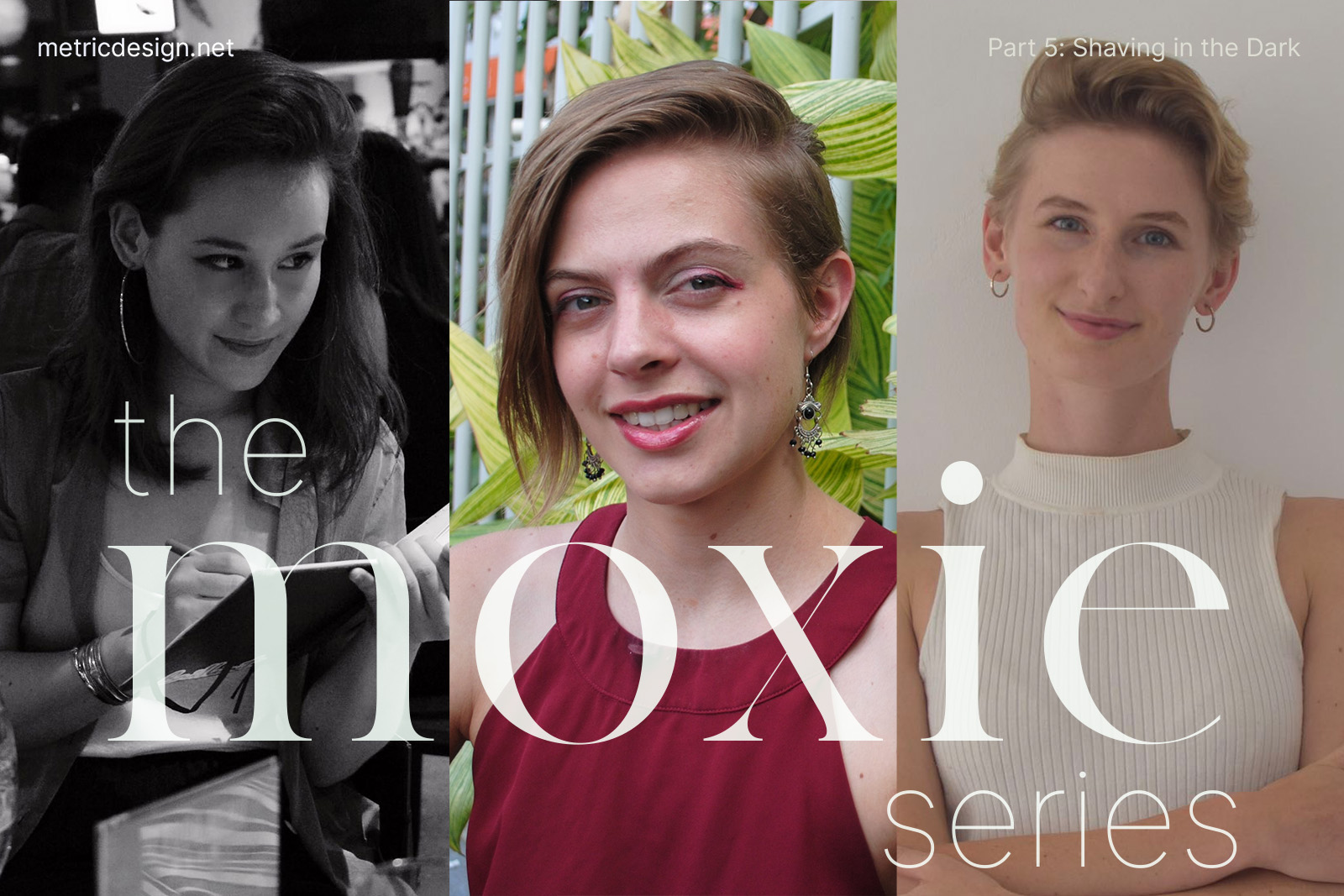
The Moxie Series: Shaving in the Dark
The Moxie Series is an interview series by MDS that shines a spotlight on innovative female entrepreneurs, creators, and trailblazers making waves in China. We asked them for behind the scenes insight onto their inspirations, work experiences, and hopes for the future.
Moxie系列是MDS推出的访谈系列,聚焦于中国的创新女性企业家、创意者和在中国掀起浪潮的开拓者。MDS通过访问这些工作幕后,深挖她们的灵感、工作经验以及对于未来的希望。

Shaving in the Dark (SITD) is a Shanghai-based culturally-inclusive collective of comic and illustration artists. The collective publishes quarterly zines and hosts monthly art workshops and events to build the indie-comics community in Shanghai. SITD was founded by Zovi Weng in 2017, and has since passed the leadership to other Shavers, including Addie Grosse and Jeni Windall, among others.

How did you get your start in cartooning and writing?
[ZOVI] I’ve always been drawing, but I professionally started freelancing back in 2016. Then I started making weekly comics for Tuzki the white rabbit, the oldest WeChat sticker (of course you know him) – that’s when I started Shaving in the Dark, because it was my first full-time job as an illustrator and I didn’t want to lose my voice as an independent illustrator – and later I got recruited by Ernst & Young, a global consulting firm, to be their in-house live illustrator. I quit that job last March, after 2 years, because of a surprise COVID-relocation in New York City. And now I’m back to freelancing.
[ADDIE] Like Zovi, I’ve been drawing in one form or another since I could hold a marker, but it was actually by meeting working artists through Shaving that I found the confidence to start freelancing. It’s an environment that gives the novice a chance to show their work to pros, and receive as much encouragement as feedback!
[JENI] I’ve also been drawing for most of my life, though I hadn’t really come into contact with comics before Shaving in the Dark. It was an eye-opening experience, both in terms of meeting these passionate people, and in terms of building my own confidence in my art. I totally agree with Addie – that’s exactly how I felt joining this community.

What was the inspiration behind the name “Shaving in the Dark”?
[ZOVI] The collective started one evening of spring 2017 at Daga Brewpub, on Fuxing Road, where I had gathered comics enthusiasts and illustrators who wanted to do something together. When I asked them what, most of them said, ‘I just want a theme and a deadline to push myself to draw!’ So we decided to make a zine from submissions. We brainstormed names. JJ (Jonathan Wilson – IG @thefinalbaws) mentioned this idiom his grandparents would use that means “not knowing what you’re doing, but doing it anyways”, which is the core of the Shaving in the Dark spirit: take risks, and have fun with it!


What was the cartoon/comics community in Shanghai like before the start of SITD?
[ZOVI] I hadn’t found any community for illustrators specifically (and particularly for international ones). There were many places for designers – I remember clearly having a drink with a designer friend of mine and telling him how I wished there was a place for low-key, indie, gritty comics. He told me – so, create it! Most magazines I was seeing were super polished, super expensive and not even about being funny… at first, I wanted to find a way to make really cheap and dirty leaflets to put in bar and restaurants toilets, for people to read while they’re busy! That model could work in France, but probably not in Shanghai, where even though indie comics are getting more popular, it’s rather as a staple of modern youngster life. I doubt any sponsor would let us distribute in washrooms… hahaha.
[ADDIE] This tracks with what I’ve heard from other long-time-shanghai illustrators. Basically, that there was (and still is) a lot of enthusiasm for sequential art among Shanghai artists, but with the in and out flux of the community there wasn’t a way to get quickly plugged into the indie comics scene in Shanghai. Now, even if you only have a few months in the city, it’s easy to get connected with people, and share your work. Find support, or collaborators, put yourself out there.
[JENI] I don’t know a lot about the community before Shaving, I was lucky enough to come on board when it was in full swing. But I do feel like its success speaks to the need for an outlet and a community like this.

Of the ten issues released, which one has been your favorite?
[ZOVI] Issue #6, the MUTE issue. We were in a paradoxical situation where we had created a space for international artists, but local artists would feel intimidated by SiTD, and estranged by a cultural and language barrier. So I decided to make an issue collecting submissions with no words. I love that number so much. I mean, I love them all, but that one means a lot to me!
[ADDIE] Oh wow! MUTE is my favorite as well! I always recommend people give that one a look. With no words or sound effects on the pages, the stories are told entirely through image. I think that not only did this issue open the gates for more Chinese submissions, but it continues to draw people into Shaving across linguistic barriers every time we put a re-print out for sale.
[JENI] I agree that MUTE did something really cool, but I have to say one of my favorites is Issue #5, TRIP – because I feel there’s a real mix of styles going on in there. I also am going to say Issue #10, JUNK, because it’s the first issue we released without Zovi and if you look closely at the pages you can see some of my blood, sweat and tears. Also it’s absolutely gorgeous (I’m not biased at all).

How has SITD helped bridge Chinese and western voices together?
[ZOVI] The issue #6 mentioned above was really what pulled everyone together. After issue #6, local artists started showing up more, and we also felt more confident to take part more in the local scene, and now our mix of both is something I’m really proud of.
[ADDIE] Each issue is an open call. This is true regardless of language. But we tend to get more English submissions. I think where you get the most bridging happening is at our events. We are able to draw a good mix of Chinese and Western artist/writers together. As the night goes on, with a little booze, and a few collaborative drawing challenges people find connection over the shared love of art and indie comics. A mutual love of the weird.
[JENI] ‘A mutual love of the weird’ is a brilliant way to put it. I do feel the bond is a lot stronger during events. Drinking together, drawing together, making each other laugh with dumb visual jokes.

What challenges have you faced with organizing events, before and after COVID?
[ZOVI] I’ll only speak of precovid world, cause I haven’t been back since. We had been nomading our way through the city, but also saw the usual rate of great places close… every time we thought we had a HQ, it was never really stable enough in the fluctuating shanghai landscape. We’re also always staying careful. As the local artists advised us, “the indie publishing scene is fine! For now… “.
[ADDIE] Before COVID our challenges were run-of-the-mill events kerfuffles. Can we find a venue the right size? Do they have a decent mic system? That sort of thing. During the COVID lockdown in SH we had no problems at all because we had no events. During this time our community stayed so active it blew me away. The 250+ members of our WeChat group were posting new art every day, offering words of support, and encouraging creativity throughout the crisis. The aftermath of the city opening up presented some real challenges. Not so much where attendance was concerned, once the city was rolling people were eager to get out and do something fun. The real trouble was with printing issue 10. With no hope of a launch party during lockdown we postponed formatting and printing. Unfortunately, the backlog of freelance work and printing requests post-quarantine waylaid our project, and we had to postpone the release until just this past month while we waited for the physical copies of the Zine to come through.
[JENI] The biggest challenge COVID presented me with was trying to fill all the roles, or find people to fill all the roles, that Zovi took. Of course we still have our amazing designer, Theophile (Insta: @theophile.signard), but Zovi was really spending so much time and energy on the Zine and events. We didn’t realize quite how much until she was gone! But we’re tackling it with the same spirit the zine was founded with – that ‘take risks, have fun’ attitude.

What makes comics and illustrations such a powerful vehicle in sharing diverse stories?
[ZOVI] Personally, I grew up with comics as a tool for seeing the world with a humorous lens. I practice comics as a therapy: whatever happens to me, the good, the bad and the ugly, I turn it into short panels that force me to take a step back and see things from another angle, and that’s key to understanding what is so unique about comics as an expression vehicle. In my profession, as a live illustrator for conferences and seminars, I use comics, illustration and storytelling blended with infographics and analysis. After hearing a speaker share a compact hour of fascinating but abstract content, instead of having to re-read it in a text version or watch the same thing in a video, I give the audience an interpretation of that content that engages them and tells the story from my eyes. And that’s the other key element: in comics, the reader is in many ways an actor of a story that he can unfold at his/her own rhythm.
[ADDIE] Comics are uniquely accessible. The medium, much like film, has the potential to layer meanings between the written word and visual language i.e. the art. But, unlike film, comics, by necessity, distil visual langue down to the essential. How do you show the complete action of a daily commute, or the feeling of intense longing in a single image, a single panel? That’s what comics have to do, they speak in an essentialized visual language that, while not always, is often accessible across culture and language in a way that other media is not. This is why comics are often used as a teaching tool in foreign language textbooks. I always recommend that Chinese language learners download a Chinese webcomic reading app on their phone or desktop. Because even if you only know fairly basic classroom language, you can follow a relatively complex high school drama. The excitement of the story keeps you coming back, the visual langue offers the context clues for the written words you don’t know. This is what makes comics a powerful vehicle to share diverse stories. Even if your story is specific to your experience (ideological, racial, gendered, what have you) comics have an unrivaled potential to make that experience accessible to others, while maintaining the complexity and truth of the narrative.
[JENI] Honestly, I have nothing to add to this. These two have it covered.


How do comics and illustrations influence Chinese youths’ perception of the arts?
[ZOVI] Comics and illustrations have a powerful effect both on young kids… and on less young kids! But for the Chinese youth, I think that the bloom of the independent scene is really important now. It’s a relatively free space compared to other media industries. Many of them first get into it through manga and anime, and there is definitely something cultural about difference and proximity, an exoticism that’s not entirely foreign, that makes it a safe space to grow and explore. Just look at the amazing yaoi (boy’s love manga trend) costumes you see these teenagers rock at comic con!
[ADDIE] I won’t claim an expertise here. Shaving does not put on a lot of kid-friendly events, though, I am proud to say whenever we’ve had families in attendance our regulars have risen to the challenge of drawing in a PG-13 realm! I will say that Chinese kids are exposed to a lot of comics and illustration. With the rise of smartphone use, and the corresponding development of scrolling webcomics, comics are increasingly available to anyone with wifi.
[JENI] When I first started getting involved with Shaving I thought I hadn’t come across comics before, but then I remembered that comics (Dandy, Beano) were the first things I spent my pocket money on! Comics are a great way to sneak art into kids’ lives, wherever they live.

What advice would you give budding artists trying to make their own mark in the industry?
[ZOVI] It’s hard to say, especially since I’m in New York City now and it’s so different. In Shanghai, your luck is that there are so, so many opportunities that you’ll never encounter elsewhere. Stay open, so you’ll be ready to catch yours when it comes!
[ADDIE] You aren’t an artist because you get a show, or a writer because you get published. You’re an artist because you make art, and you’re a writer because you write.
[JENI] Great advice from both Zovi and Addie. I’d also say get away from Instagram or “what’s popular”. Try and consume as much interesting stuff as possible.

What will Shanghai’s art scene look like in 10 years?
[ZOVI] Standards will have risen, and the sea of opportunity will probably have moved elsewhere. I‘m not sure if the thirst for foreign creativity will still be there. I really hope there will be less barriers for artists to express themselves.
[ADDIE] Oh~ Zovi my sweet summer child! Ten years from now should be the early days of the robot uprising. I’m planning to be killed in the first wave. Murdered by my own drawing tablet. I will deserve it.
[JENI] Yeah, perhaps the thirst for foreign creativity will not be as strong but I really want to see Shanghai develop its own creative ‘voice’. I’d love to see more and more Chinese artists putting their own stamp on the world, and encouraging others to do the same.

What does the future hold for SITD?
[ZOVI] I’m not the one to ask about that anymore, but what I know is that it’s in good hands! It was probably a good time for me to leave, even though it happened in quite a sudden manner. I’m proud to see ‘em Keep Shaving on!
[ADDIE] We’re just hopin’ to do mama Zovi proud! Zovi has built up a fantastic community here in Shanghai, now I hope we can provide members of that community with more resources to push their work to the next level. To that end I hope to put together more workshops, panel discussions with pros in Shanghai, and artist retreats.
[JENI] I want Shaving in the Dark to always be able to do what it did for me – to give people the confidence to take their art into public and to allow them to create connections with the best people in Shanghai. That’s the most important part for me.
You can find Shaving in the Dark at https://shavinginthedark.wixsite.com/website. Follow them on WeChat at shavinginthedark and Instagram at @shavinginthedark for updates.

Interview conducted by Jennifer Cheung of MDS.
If you would like to nominate someone to be featured in the Moxie Series next, please reach out to marketing@metricdesign.net.
The Moxie Series is an interview series by MDS that shines a spotlight on innovative female entrepreneurs, creators, and trailblazers making waves in China. We asked them for behind the scenes insight onto their inspirations, work experiences, and hopes for the future
Metric Design Studio (MDS) is an award-winning, independently owned integrated digital agency in Shanghai. We specialize in web design & development, graphic design, e-commerce management, and WeChat solutions.


Leave a comment